Your arch doesn't need support. It needs work.
This setup forces your arch and toes to do the work they were built for. Most people with plantar pain have never trained these muscles. That's exactly why the pain keeps coming back.
Έχετε λογαριασμό;
Συνδεθείτε για ταχύτερη ολοκλήρωση των αγορών σας.

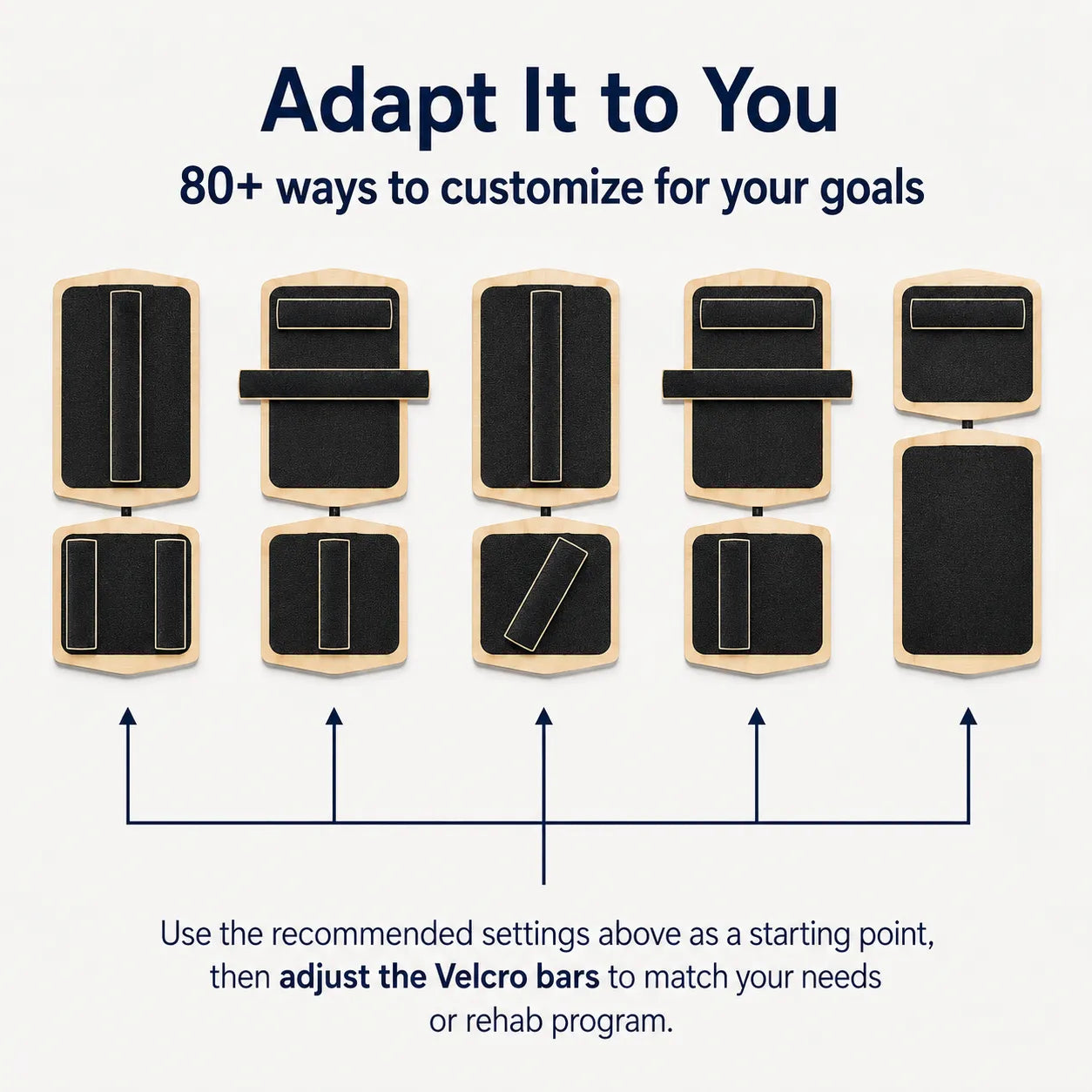
Three common foot and ankle issues. One board. A different Velcro setup for each.
This setup forces your arch and toes to do the work they were built for. Most people with plantar pain have never trained these muscles. That's exactly why the pain keeps coming back.
Standing on an unstable back foot forces your Achilles to load and react constantly. That's the controlled loading that actually fixes a weak tendon, the real root of Achilles pain. Rest and stretching just quiet the pain for a few days.
Stacking the back bars lifts your heel and tips your ankle into a toes-down position. That's the same position high heels force, and the position most ankles sprain in. Training there, under control, rebuilds the reflexes and muscles on the outside of your ankle. You're not just recovering. You're fixing what let it happen in the first place.
Trains proprioception, the stabilizing reflex that catches your ankle before it rolls.
Used by people recovering from sprains, Achilles tendonitis, plantar fasciitis, and posterior tibial tendon issues.
Daily eccentric work may help release tension along the arch and heel cord.
Three movable Velcro bars let beginners and athletes find the right level.
Small enough for a closet, gym bag, or under your desk. No setup. No app.
The same mechanism used in clinical balance boards, at an accessible price.
3 to 5 short sessions a week, around 5 to 10 minutes each. Short and frequent beats long and occasional.
Daily controlled stretching and strengthening may help ease tension along the arch and heel cord. It's not a miracle cure and it's not instant.
Used as designed (bodyweight, strengthening, stretching), absolutely. It's not built for jumping or weighted training.
No. The board, the bars, and the connecting cord are everything you need for the core exercises.
Yes. Athletes use boards like this for prehab, ankle stability, sharper proprioception (body awareness), and faster reaction time.
Start with maximum stability (bars further apart). As you get stronger, move them inward.
For prehab, balance, and general strengthening, yes. For active rehab from a fresh injury, check in with your physical therapist first.
A round board moves in every direction at once and trains general balance. The two-panel design isolates the ankle joint specifically.
Real reviews from verified buyers
Based on 12,061 reviews
Feels solid, easy to use, and helps me keep up with my ankle exercises at home.
Ordered two weeks ago, it arrived, and it's really good. Works great.
Bought it after a recurring sprain. A few weeks in and my ankle feels so much better.
Excellent for balance training.
Doesn't slip at all, even barefoot.
Love that you can adjust the difficulty level.
My physical therapist recommended it and it really helps.
Simple, sturdy, and way better than I expected. 🙏
I recommend it. I came back to order another one and it asked me to leave a review.
It's really tiny, but in a good way lol.
Good.
👍