Your arch doesn't need support. It needs work.
This setup forces your arch and toes to do the work they were built for. Most people with plantar pain have never trained these muscles. That's exactly why the pain keeps coming back.
Hast du ein Konto?
Logge dich ein, damit es beim Checkout schneller geht.

Three common foot and ankle issues. One board. A different Velcro setup for each.
This setup forces your arch and toes to do the work they were built for. Most people with plantar pain have never trained these muscles. That's exactly why the pain keeps coming back.
Standing on an unstable back foot forces your Achilles to load and react constantly. That's the controlled loading that actually fixes a weak tendon, the real root of Achilles pain. Rest and stretching just quiet the pain for a few days.
Stacking the back bars lifts your heel and tips your ankle into a toes-down position. That's the same position high heels force, and the position most ankles sprain in. Training there, under control, rebuilds the reflexes and muscles on the outside of your ankle. You're not just recovering. You're fixing what let it happen in the first place.
Trains proprioception, the stabilizing reflex that catches your ankle before it rolls.
Used by people recovering from sprains, Achilles tendonitis, plantar fasciitis, and posterior tibial tendon issues.
Daily eccentric work may help release tension along the arch and heel cord.
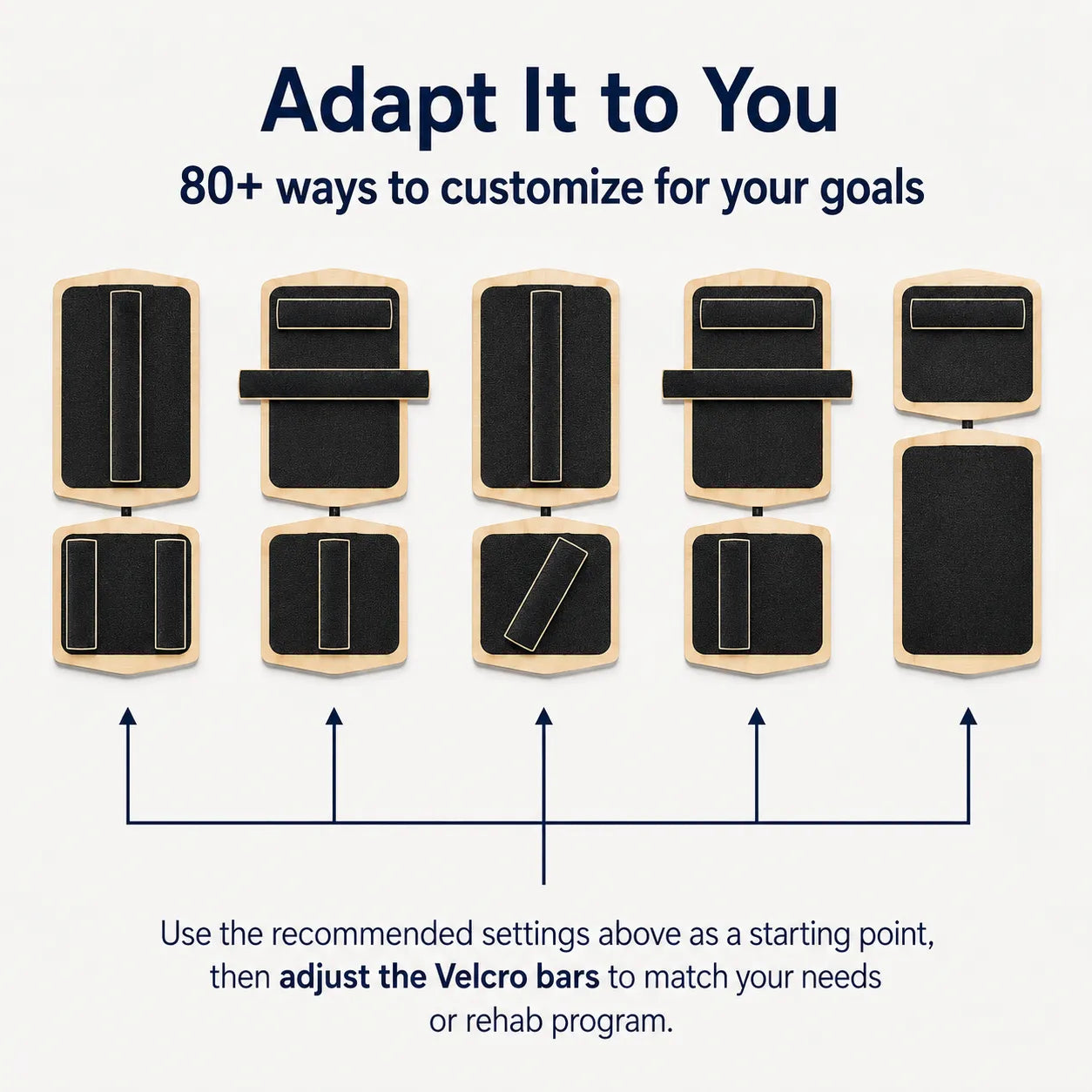
Three movable Velcro bars let beginners and athletes find the right level.
Small enough for a closet, gym bag, or under your desk. No setup. No app.
The same mechanism used in clinical balance boards, at an accessible price.
3 bis 5 kurze Einheiten pro Woche, jeweils etwa 5 bis 10 Minuten. Kurz und häufig ist besser als lang und gelegentlich.
Tägliches kontrolliertes Dehnen und Kräftigen kann helfen, Spannungen entlang des Fußgewölbes und der Achillessehne zu lindern. Es ist kein Wundermittel und wirkt nicht sofort.
Wie entworfen verwendet (Körpergewicht, Kräftigung, Dehnung), absolut. Es ist nicht für Sprünge oder Gewichtstraining gebaut.
Nein. Das Brett, die Stangen und das Verbindungskabel sind alles, was Sie für die Kernübungen benötigen.
Ja. Sportler nutzen solche Bretter für Prehab, Knöchelstabilität, eine schärfere Propriozeption (Körperwahrnehmung) und eine schnellere Reaktionszeit.
Beginnen Sie mit maximaler Stabilität (Stangen weiter auseinander). Wenn Sie stärker werden, bewegen Sie sie nach innen.
Für Prävention, Gleichgewicht und allgemeine Kräftigung, ja. Für die aktive Rehabilitation nach einer frischen Verletzung sollten Sie zuerst Ihren Physiotherapeuten konsultieren.
Ein rundes Brett bewegt sich in alle Richtungen gleichzeitig und trainiert das allgemeine Gleichgewicht. Das zweiteilige Design isoliert gezielt das Sprunggelenk.
Echte Bewertungen von verifizierten Käufern
Basierend auf 12.061 Bewertungen
Fühlt sich stabil an, ist einfach zu bedienen und hilft mir, meine Knöchelübungen zu Hause durchzuführen.
Vor zwei Wochen bestellt, ist es angekommen und wirklich gut. Funktioniert super.
Ich habe es nach einer wiederkehrenden Verstauchung gekauft. Nach ein paar Wochen geht es meinem Knöchel viel besser.
Ausgezeichnet für das Gleichgewichtstraining.
Rutscht überhaupt nicht, auch nicht barfuß.
Ich finde es toll, dass man den Schwierigkeitsgrad anpassen kann.
Mein Physiotherapeut hat es empfohlen und es hilft wirklich.
Einfach, stabil und viel besser, als ich erwartet hatte. 🙏
Ich empfehle es. Ich kam zurück, um ein weiteres zu bestellen, und es bat mich, eine Bewertung abzugeben.
Es ist wirklich winzig, aber auf eine gute Art und Weise, lol.
Gut.
👍